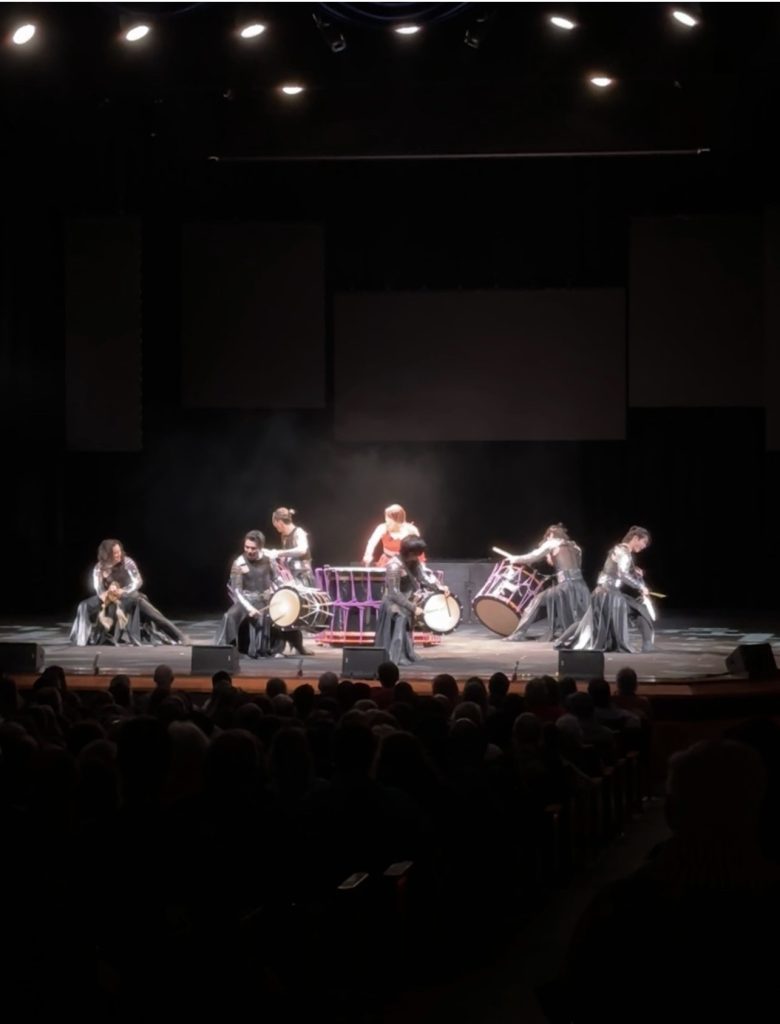
Walking into the Weis Center for the Performing Arts to watch Drum Tao, I noticed the crowd before anything else. On a night when the cold felt especially unforgiving, when staying inside would have been easier, the hall was full. Families sat beside students. Faculty members greeted neighbors. Coats were folded over armrests. Programs were already open in people’s hands. Everyone had come ready to give the evening their attention.
When the performance began, the sound moved through the room like a wave. It started at the stage and spread outward, passing through the seats, the floor and the walls before settling into our bodies. You could see people adjust without realizing it. Shoulders relaxed. Backs straightened. Conversations stopped mid-sentence. Breathing slowed. Eyes stayed fixed on the stage. Some leaned forward. Others sat completely still. The outside world faded, not because it was pushed away, but because there was no space left for it.
What makes Drum Tao so compelling is the balance they hold between force and precision. The drums demand physical endurance. Each strike requires full commitment. At the same time, every movement is measured. Nothing feels rushed or careless. Dance and music move together, responding to one another rather than competing. Strength never overwhelms control. Control never dulls expression. Watching them feels less like observing separate performers and more like witnessing one continuous exchange unfolding on stage.
Throughout the performance, there was also a deep sense of cultural pride woven into every movement. From the traditional patterns to the disciplined posture and ceremonial gestures, it was clear that this was more than technical mastery. The performers carried Japan’s history, values and traditions into each sequence.
One of the most striking elements of the night was the presence of women on stage. From the opening sequences, they led with confidence and control. They set the pace and anchored transitions. Even in moments when men stepped forward, the structure of the performance continued to rest with the women. Their presence carried continuity. Strength here was not loud or dominating. It was grounded and sustaining.
Despite the intensity of the performance, there was also warmth woven throughout. Performers smiled at one another and exchanged playful glances. At times, they leaned into humor, reacting to one another in ways that drew laughter from the audience. They teased each other lightly. They played with timing. They acknowledged small surprises on stage. These moments never felt staged. They felt genuine, reminders that discipline and joy can exist side by side.
That openness extended to the audience as well. We were not treated as distant observers. We were invited in. Clapping became part of certain sequences. Laughter filled the spaces between movements. Energy moved easily between stage and seats. It felt less like watching something happen and more like being included in it.
The level of preparation behind the performance was unmistakable. Every transition was seamless. Every entrance was intentional. Years of training were visible in the smallest details. Yet nothing felt mechanical. The performers remained fully present, attentive to one another and to the room, adjusting in real time as the night unfolded.
As the evening continued, individual performers seemed to merge into something larger. At times, they moved as one body. At others, they separated and rejoined, forming new patterns. No one carried the performance alone. Everything was built on connection, trust and shared responsibility.
The final section slowed the pace. After so much movement and force, space was made for stillness. The drums softened. Gestures became deliberate. When the last sound faded, there was a pause before the applause began. No one rushed to break the moment.
When the clapping finally came, it filled the hall. People stood. Smiles were exchanged. Some faces held emotion. Others reflected simple awe. It felt less like celebration and more like gratitude.
Outside the auditorium, the energy continued. A line formed at the merchandise table, where students compared shirts and posters, parents helped children choose souvenirs and friends debated which designs they liked best. It felt less like shopping and more like holding onto a memory, a way of keeping part of the night close.
In the lobby, conversations flowed easily. Strangers exchanged favorite moments. Some tried to recreate drum patterns on their hands or legs. Others stood nearby, still absorbing what they had seen. The performance had ended, but it had not disappeared. It lived on in voices, gestures and shared reflections.
Drum Tao gave more than a performance. They offered connection, discipline and pride. They showed how tradition lives through people, how love for one’s culture can be expressed through dedication and care, and how art becomes complete when it is shared. As we stepped back into the cold, each of us carried something with us. A feeling that stayed in the body. A reminder of what it means to be part of something larger, even for one evening.