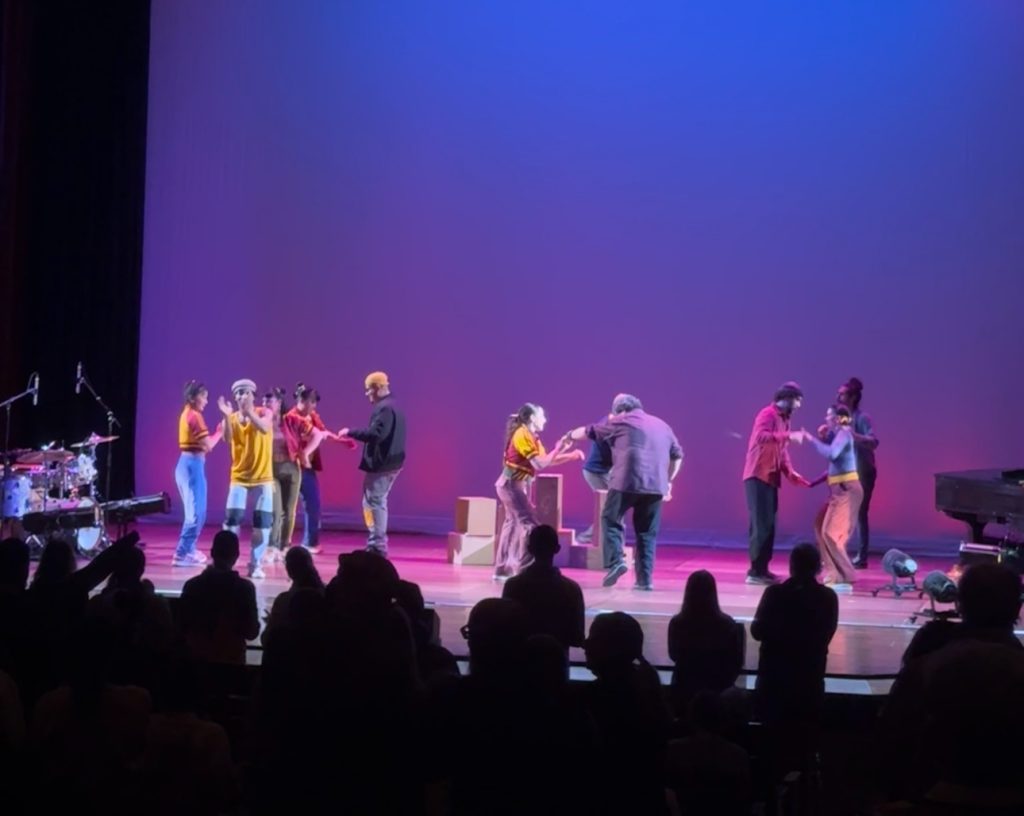
Watching Ephrat Asherie and her company at the Weis Center for the Performing Arts felt unexpectedly familiar. From the opening sequence, where the performers entered with loose confidence and settled into a shared groove, the stage carried an energy that felt both contemporary and nostalgic. The movement drew from breaking, hip hop and social dance traditions, but it never felt like a history lesson. It felt lived in.
What stood out most was the precision within the looseness. The performers shifted in and out of formation with ease. At one point, the entire group moved in tight unison, their footwork landing at the same second, shoulders hitting accents in the music without hesitation. Then, just as quickly, the formation opened up and individuals stepped forward, offering their own textures and rhythms before folding back into the group. It was seamless. No transition felt abrupt.
There were sections where the stage stripped back to almost nothing. A piano carried the space while the performers responded with smaller, grounded movements. In another moment, there was no music at all. Just breath, sneakers against the floor and bodies carving through silence. Those choices made the louder, more energetic sequences feel earned. The contrast kept the audience alert.
As the performance unfolded, it became clear that this work was also about honoring the communities these movement styles come from. Breaking, hip hop and social dances have deep roots in African American and Latinx neighborhoods, shaped by creativity, resilience and collective expression. Onstage, those histories were not treated as something distant or decorative. They were present in the way the dancers moved with confidence, in the way they listened to one another and in the way individuality was always held within community.
Rather than separating “high art” from street and social forms, the performance blurred that line entirely. The dancers brought styles that were born in parks, block parties and community spaces into a formal theater without losing their spirit. Nothing felt watered down. The swagger, softness, playfulness and edge all remained intact. It felt like an act of respect, showing that these traditions deserve space on major stages without being reshaped to fit someone else’s idea of refinement.
The performance ran about an hour, and it held that balance the entire time. It never relied on spectacle. Instead, it relied on timing, spacing and trust between performers. You could see it in the way they caught each other’s cues, the way eye contact replaced obvious signals, the way lifts and floorwork unfolded without visible strain.
As a college student watching it, the impact felt personal in a grounded way. Sitting there, I was not just admiring technique. I was thinking about what it means to move alongside other people, to build something collectively. In college, so much of life is about collaboration, about learning how to exist in shared spaces. Watching the performers negotiate space, give room, step forward and then step back felt familiar. It reminded me of group projects that finally click, of friendships that find their rhythm over time, of communities that only work when everyone pays attention to one another.
At the same time, the performance encouraged reflection on whose stories and cultures are often centered in artistic spaces. Seeing African American and Latinx movement traditions presented with such care and confidence felt meaningful. It was a reminder that these forms are not trends or background influences. They are foundations. They carry histories of joy, struggle, resistance and survival, and they continue to shape contemporary culture in powerful ways.
It also brought back memories of the shows and films I grew up with, where dance sequences were less about perfection and more about connection. That same spirit was present here. Even in technically demanding passages, there was ease. Even in solos, there was awareness of the group waiting just off center.
When the performance ended, it felt complete. Not dramatic for the sake of it. Just full. The kind of show that leaves you energized but steady. The kind that reminds you that movement can tell stories without overcomplicating them.
This was not only entertaining. It was cohesive, intentional and human.