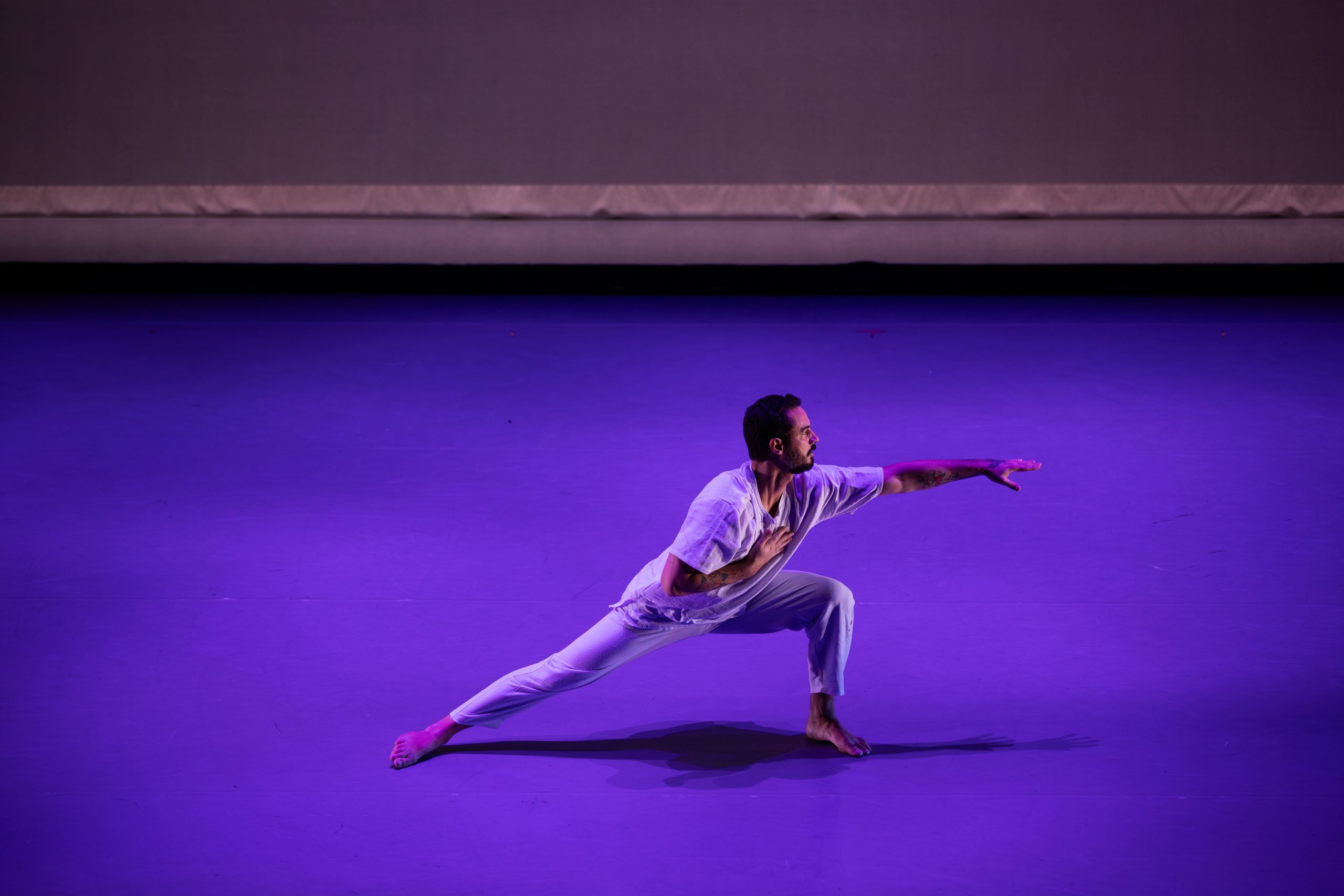
The Weis Center will present “Ori: An Exploration of Brazilian Dance and Music” on Sunday, October 25 at 2 p.m. in the Weis Center Concert Hall. The performance is free and tickets are not required.
There will be a pre-performance artist talk with Jaruam Xavier from 1:15-1:45 p.m. in the Atrium facilitated by Professor Matias Vernengo.
Assistant Professor of Theatre & Dance at Bucknell University Jaruam Xavier will present a concert dance work that combines the lively rhythms of samba and the fluid agility of capoeira with contemporary dance. Through grounded footwork, circular movements and shared momentum, it celebrates Brazilian heritage by reimagining traditional elements on a modern stage. The piece will feature live guitar music.
The performance is co-sponsored by Bucknell’s Griot Institute for the Study of Black Lives & Cultures.
The runtime for Ori is 70 minutes with a 5-minute technical intermission. The performance order is as follows: Live Music – 25 minutes, 5-minute intermission, Dance – 45 minutes.
Jaruam Xavier said, “The experience is deeply embedded in my memories and body, serving as a performance that aims to evoke sacredness and spirituality. Its goal is to elevate consciousness and articulate the sacred language of the present moment.”
Xavier’s journey began with his grandfather’s love of tap-dance movies. Xavier started dancing at 10, decided as a teenager that he wanted to become a professional dancer and received his first professional contract at 18. His career later took him through several dance companies in Brazil and performances around the world before he came to the United States for graduate school and joined Bucknell’s faculty in 2024.
Ori carries pieces of that history onto the stage. The work began while Xavier was a graduate student at the University of Iowa as a short solo inspired in part by his experiences with Candomblé, an Afro-Brazilian religious tradition that had been part of his own life. He continued returning to the piece, allowing each performance to reshape what it could become.
Over time, Ori grew into a larger exploration of Brazilian dance and music. Xavier draws from samba and capoeira alongside contemporary movement, but he is not interested in presenting those forms as separate categories.
“It’s not a recipe,” Xavier said.
After decades of dancing, the different forms have become part of his muscle memory. A movement from capoeira may meet something from ballet or contemporary dance without a clear line dividing one from the other. Xavier is more interested in what happens at the point where they begin to overlap.
That blending reflects the Brazil he wants audiences to encounter as well.
“We are not only one thing,” Xavier said. “We are very mixed.”
Brazilian culture has been shaped by Indigenous peoples alongside African and European traditions, and Ori allows those histories to exist together onstage. Some of the movement also carries a history of resistance. Xavier points to capoeira as one example of a tradition that survives because generations of people continued to practice and preserve it.
Spirituality is also central to Ori. Xavier has long been interested in ritual and in the meaning movement can hold within a spiritual setting. In Ori, he asks what happens when movement inspired by those experiences is taken out of that setting and placed on a stage.
“I still want to see if it’s possible to evoke the same spiritual connection, even though it’s not like participating in a ritual,” Xavier said.
He is not trying to recreate a Candomblé ritual for an audience. Instead, the performance gives those memories and movements another space to exist. Some moments may feel familiar while others remain abstract, and Xavier is comfortable with different people seeing different things in the work.
The performance on Sunday, October 25th is free and tickets are not required.