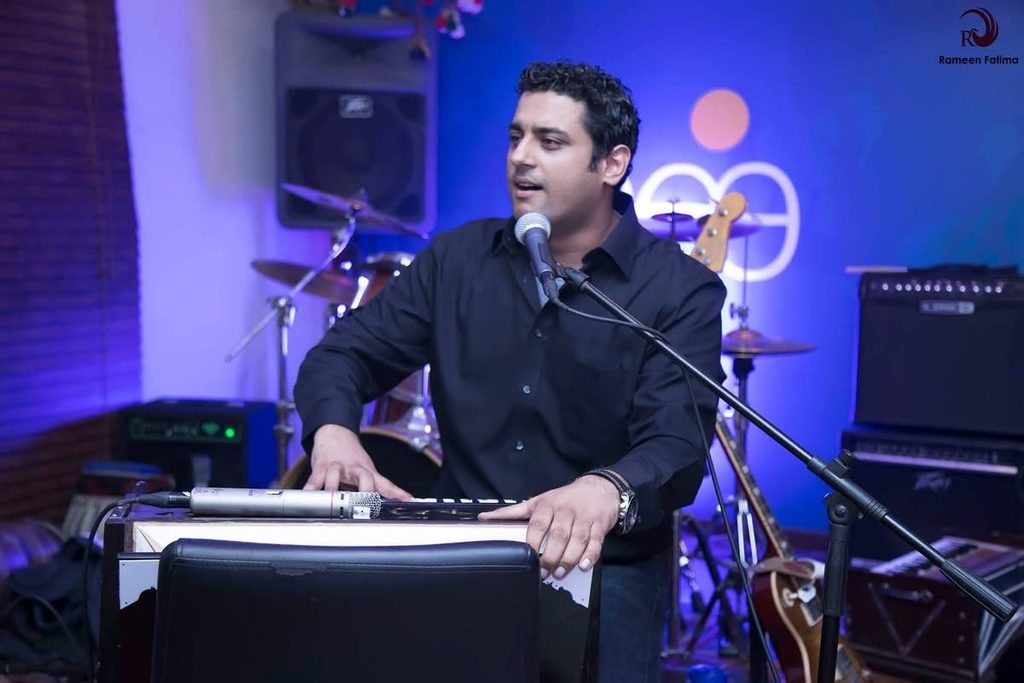
Ahead of his Oct. 15 performance at the Weis Center, Bucknell Professor of Economics
Shahram Azhar sat down with us to talk about his lifelong relationship with music and the ideas
behind From the Wound to the Dawn. The evening draws from North Indian and Pakistani
classical music, Urdu and Punjabi poetry and Azhar’s own compositions.
In this conversation, Azhar reflects on discovering music as a child in Pakistan, the unexpected
connections between music and economics, the spirituality behind his work and the personal
experiences that shaped this performance.
You started singing at a very young age. How did music first become part of your life?
I have had a long and emotionally tumultuous relationship with music. My father died when I was about six, and that had a very profound impact on me. Around that age, I started singing ghazals. I didn’t necessarily understand everything I was singing at six or six and a half, but I could still connect with the melancholy in them. I think part of that also comes from the culture I grew up in. We don’t necessarily segregate music and literature from other modes of knowledge. In our part of the world, people like Ghalib, Mir and Faiz are poets, but they are also philosophers and thinkers. Poetry becomes one of the ways you think about life. So I was naturally drawn toward it. I have always had what I would call a melancholic relationship with music. Whenever I have experienced defeat, failure, trauma or grief, I have returned to music as a way of dealing with reality. It lets me reach aspects of my own soul and emotions that I sometimes shut down in my normal life.
You eventually pursued economics while continuing to make music. Do those two parts of your life connect with each other?
They seem like two completely different fields, but I think there is a connection through pattern recognition. Music is fundamentally about recognizing patterns. Rhythm gives you structure, and you begin to notice relationships between things. There are similar ways of thinking in economics. Music has even affected the way I think about writing. There is an intonation to an article. There is a rhythm to how an argument moves. I think my musical training has influenced the way I pay attention to those things. But the deeper connection is philosophical. I am interested in things that can move human consciousness forward. Economics gives me one way of thinking about human beings and the world. Music gives me another. I also made a conscious decision not to turn music completely into a career. I didn’t want to sell the talent. If 10 people are listening and genuinely connecting with what I am doing, that can mean more to me than reaching a huge audience for the sake of reaching one. There were practical reasons for choosing an academic career too, but keeping music separate in this way has protected my relationship with it.
Has your relationship with music changed since moving to the United States?
Absolutely. One of the things I have appreciated about coming to the United States is that I have been introduced to musicians from so many different traditions. That has exposed me to different kinds of music and had a very positive effect on what I create. I started experimenting more with fusion and even setting English poetry to music. I have worked with American folk and bluegrass influences, for example. Those encounters have affected both the form and the substance of my music. At the same time, I haven’t left behind the tradition I came from. If anything, being away from home sometimes makes you think more deeply about where you come from. There is also something about Lewisburg that has given me space to explore the spiritual side of music. So my musical life here has become a meeting point between what I carried with me and what I have encountered since coming here.
For someone coming to From the Wound to the Dawn without knowing much about North Indian or Pakistani classical music, what can they expect from the evening?
I want to introduce the audience to this enormous ocean that we call North Indian and Pakistani classical music. It is a very old tradition, and it is the result of entire civilizations coming together over centuries. South Asia met Persia, Central Asia and the Arab world, and all of those encounters contributed to an incredibly rich musical tradition. The audience will encounter instruments and sounds that are part of that history. There is also a long poetic tradition behind the music. You have poets like Bulleh Shah writing in the feminine voice about love and submission. You have Ghalib thinking about pain in ways that don’t necessarily ask for pain simply to disappear. I also want people to know that they don’t have to understand every word. Many people in the audience won’t understand Urdu or Punjabi, and that’s okay. You can listen to a poem in a language you don’t speak and still understand something about it through music. That is part of what I want people to experience.
The program follows the course of a human life. What made you want to structure the performance that way?
I think of life almost as a drama. There is an origin and there is an exit. We begin with a kind of empty slate and serenity, and in some ways the beginning and the end are similar. It is everything in the middle where the conflict happens. I wanted people to experience the different flavors that life gives us. There is nostalgia and melancholy, but there is also hope. We experience these smaller births and deaths throughout our lives. A fetus has to cease to exist for a child to be born. Childhood eventually disappears and adolescence begins. Then that version of you disappears too. Life is ephemeral in that way. So I want people to think about whether music is simply entertainment or whether it can have a spiritual impact and make us think about life itself. Poetry and music can have a cathartic effect on human beings. I have never been particularly interested in the idea of art simply for art’s sake. I think art can have a purpose. It can do something to us.
Spirituality seems to be at the heart of the performance. What does music allow you to access spiritually?
Music is one of those things that allows us to access what I call the pre-lingual self. Before we have language, we still have emotions. We still experience things. Then we enter the world of language, where we become restricted by what can be said and what cannot be said. Music can extend that. It can take us to levels that language by itself sometimes cannot reach. There is also something about frequency. Music resonates with us, and I think that can connect us with something larger than ourselves while also helping us discover something within ourselves. For me personally, music helps me stay connected with that six-year-old version of myself. That child knows nothing about economics. He doesn’t know about the world in the way I know it now. When I leave home, I put on the Professor Azhar hat. Music allows me to take that off and reconnect with a much earlier part of myself. That is part of why spirituality and music are so closely connected for me. It isn’t only about performing something beautifully. It is about reaching a different level of consciousness and trying to understand something that ordinary language may not allow you to understand.
The performance is dedicated to Hina Javed and to women who have lost their lives to femicide. How did Hina’s death shape From the Wound to the Dawn?
Hina was a member of my extended family, but I considered her a sister. Her death had a profound impact on me. When something like that happens, you can sit with the grief and remain in that dark room. But I started thinking about how that energy could flow outward instead. What can you do with grief? Can it become something that leads you toward action rather than simply remaining inside you? That became very important to this performance. The wound is the suffering, and the dawn is the hope. The wound doesn’t disappear. You don’t pretend the suffering wasn’t there. But you ask whether there can still be a dawn after it. For me, dedicating this performance to Hina and to women who have lost their lives to femicide is part of that. It is about taking something that is deeply painful and refusing to let it remain only private grief.
Two pieces in the program, “Zanjeer” and “Aa Havaa Naal,” are your own compositions. What do those songs mean to you?
“Zanjeer” means “chains,” and I released it on Aug. 14, Pakistan’s Independence Day. Pakistan became independent from British colonial rule in 1947, but the song asks what it actually means to be free. Is this the freedom we were waiting for? There was so much struggle for independence, and yet people can still feel that they are living in chains. So the chain is both an image and a question. It asks people to think about freedom rather than simply assume that independence automatically means everyone is free. “Aa Havaa Naal” comes from a different place. It brings me back to Punjabi, my mother tongue. Language matters deeply to me because there are things you can express in your own language that you cannot express in exactly the same way in another one.
Living away from your culture can also give you a sense of being uprooted. I have experienced that kind of distance and solitude in my own life. In the song, the wind becomes connected with freedom and with that feeling of being away from the place and culture that formed you. Both songs are political in their own ways, but they are also personal. They come from questions about freedom, language and what it means to carry a culture with you when you are away from it.
When you think about the title From the Wound to the Dawn, what do you hope people carry with them after the performance?
The wound is the trauma. The dawn is the hope. Suffering is part of life, but the question is whether hope remains possible within it. If there is one message I would want people to leave with, it is that music is not just entertainment. Music is a mode of knowledge. There are things that cannot always be understood through a straightforward intellectual exercise. Sometimes you have to experience them. There is something beautiful out there in the world that is abstract, that is worthy of learning and worthy of thinking about. Music can help us connect with that, but it can also connect us with something inside ourselves. And I hope there is catharsis. Psychological and emotional catharsis is important. If people leave having felt something, having connected with some part of themselves or having thought about life differently, then the music has done something meaningful.
From the Wound to the Dawn will be presented Thursday, Oct. 15 at 7:30 p.m. in the Weis
Center Atrium.