By: Shaheryar Asghar, Class of 2028
Long before Shahram Azhar became an economics professor at Bucknell, he was a six-year-old in Pakistan learning to make sense of grief through music. Long before Jaruam Xavier began teaching theatre and dance, he was a 10-year-old in Brazil who started tap dancing because he wanted to be like his grandfather.
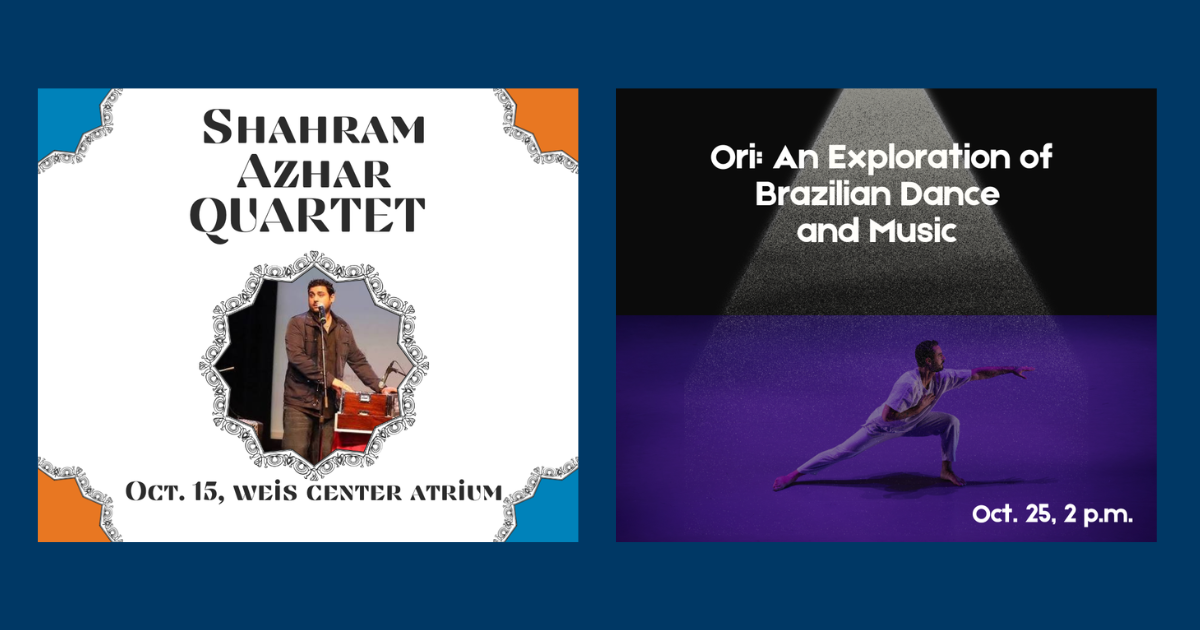
This October, those childhood connections to art will find their way to the Weis Center stage. Azhar will perform From the Wound to the Dawn on Oct. 15, an evening of Sufi fusion that uses poetry and music to move from grief toward hope. Ten days later, Xavier will present Ori: An Exploration of Brazilian Dance and Music, a dance work shaped by Brazilian traditions and memories of ritual.
The performances come from different cultures and artistic traditions, but both grow out of something deeply personal. For Azhar and Xavier, art has become a way of reaching parts of human experience that can be difficult to explain in words.
For Azhar, music has done that since childhood. He began singing ghazals around the age of six, shortly after losing his father. He did not always understand the poetry he was singing, but he understood its sadness.
“I have a melancholic relationship with music,” Azhar said. “It’s a way for me to reach aspects of my own soul and my emotions which I have shut down for myself in my normal life.”
That relationship runs through From the Wound to the Dawn. The performance follows the course of a human life, moving through different emotions before eventually arriving at what Azhar describes as the dawn.
“The wound is the suffering, and the dawn is the hope,” he said.
The idea became especially personal after the death of Hina Javed, a member of Azhar’s extended family whom he considered a sister. The performance is dedicated to her and to women who have lost their lives to femicide. Rather than allowing grief to remain private, Azhar began thinking about how music could give that grief another form.
Spirituality is central to that process. Azhar describes music as a way of returning to the “pre-lingual” self, a place where emotion exists before people have the words to describe it. That idea matters for an evening that draws heavily from Urdu and Punjabi poetry. Audience members may not understand every word, but Azhar hopes they can still understand something through the music itself.
“Music is not just entertainment,” he said. “Music is a mode of knowledge.”
Xavier approaches that same possibility through dance. His journey began with his grandfather’s love of tap-dance movies. Xavier started dancing at 10, decided as a teenager that he wanted to become a professional dancer and received his first professional contract at 18. His career later took him through several dance companies in Brazil and performances around the world before he came to the United States for graduate school and joined Bucknell’s faculty in 2024.
Ori carries pieces of that history onto the stage. The work began while Xavier was a graduate student at the University of Iowa as a short solo inspired in part by his experiences with Candomblé, an Afro-Brazilian religious tradition that had been part of his own life. He continued returning to the piece, allowing each performance to reshape what it could become.
Over time, Ori grew into a larger exploration of Brazilian dance and music. Xavier draws from samba and capoeira alongside contemporary movement, but he is not interested in presenting those forms as separate categories.
“It’s not a recipe,” Xavier said.
After decades of dancing, the different forms have become part of his muscle memory. A movement from capoeira may meet something from ballet or contemporary dance without a clear line dividing one from the other. Xavier is more interested in what happens at the point where they begin to overlap.
That blending reflects the Brazil he wants audiences to encounter as well.
“We are not only one thing,” Xavier said. “We are very mixed.”
Brazilian culture has been shaped by Indigenous peoples alongside African and European traditions, and Ori allows those histories to exist together onstage. Some of the movement also carries a history of resistance. Xavier points to capoeira as one example of a tradition that survives because generations of people continued to practice and preserve it.
Spirituality is also central to Ori. Xavier has long been interested in ritual and in the meaning movement can hold within a spiritual setting. In Ori, he asks what happens when movement inspired by those experiences is taken out of that setting and placed on a stage.
“I still want to see if it’s possible to evoke the same spiritual connection, even though it’s not like participating in a ritual,” Xavier said.
He is not trying to recreate a Candomblé ritual for an audience. Instead, the performance gives those memories and movements another space to exist. Some moments may feel familiar while others remain abstract, and Xavier is comfortable with different people seeing different things in the work.
That openness is something the two performances share. Azhar hopes music can create catharsis even when listeners do not understand every lyric. Xavier is equally comfortable with someone leaving Ori with questions rather than a single answer. In both cases, understanding does not have to come before feeling.
Their paths to Bucknell began in different countries and through different art forms, but both have carried pieces of childhood with them. For Azhar, music remains tied to some of his earliest experiences of loss. For Xavier, dance still carries the memory of wanting to follow in his grandfather’s footsteps. Years later, those early experiences are still present in what they create and in what they now bring to the Weis Center stage.
From the Wound to the Dawn will be presented Thursday, Oct. 15 at 7:30 p.m. in the Weis Center Atrium. Tickets are available at Bucknell.edu/BoxOffice or by calling 570-577-1000. Ori: An Exploration of Brazilian Dance and Music will be presented Sunday, Oct. 25 at 2 p.m. in the Weis Center Concert Hall.The Ori performance is free and tickets are not required.